
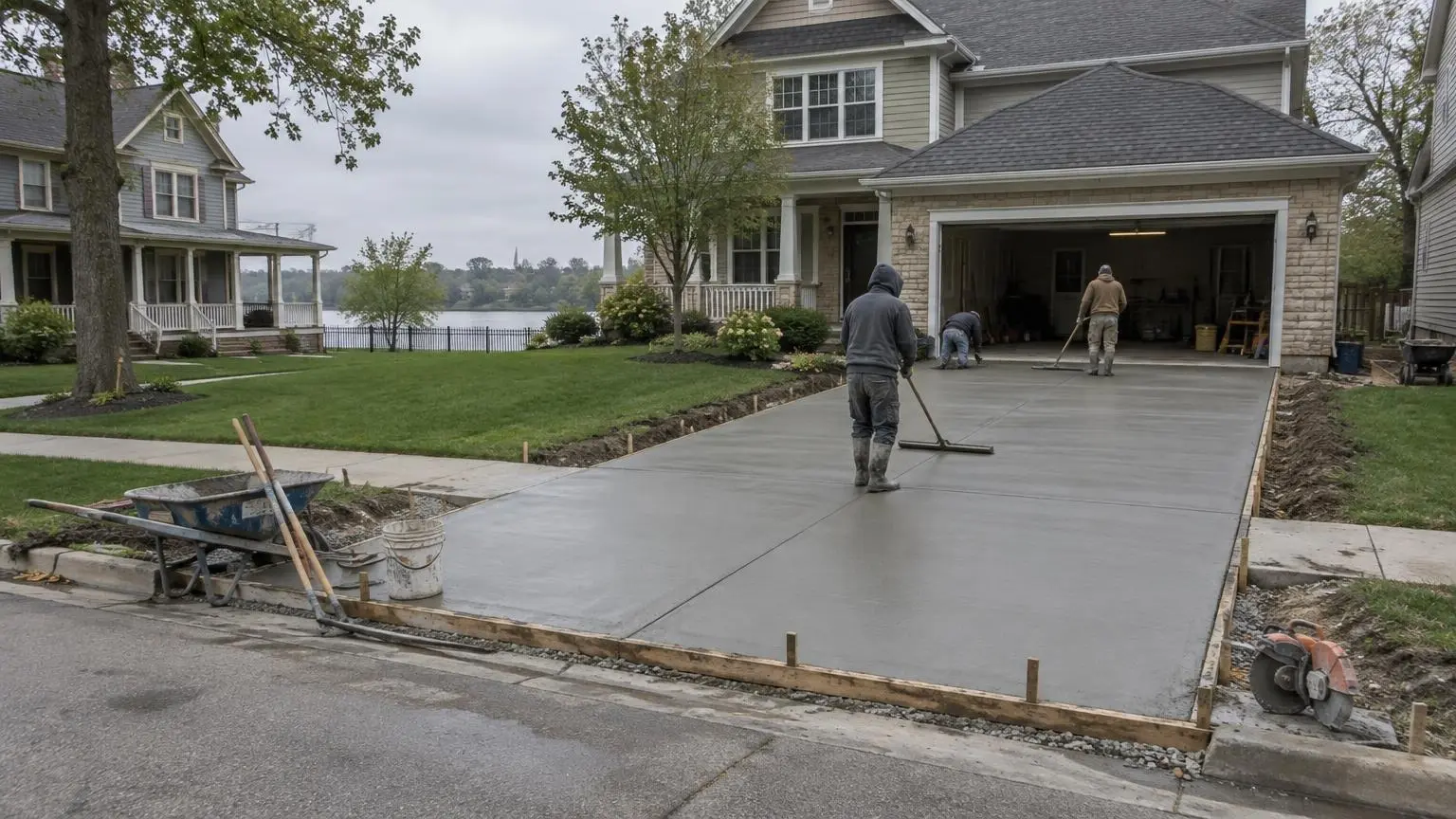
Fox Valley flatwork, poured and repaired
Concrete Contractors in Aurora, IL
Driveways, patios and walks built from the base up for salt, plows and freeze-thaw, priced in writing.
- Free measuring visit at your property
- Itemized written quote, not a lump-sum guess
- Air-entrained mix and planned joints on every outdoor slab
Concrete That Can Take an Aurora Winter
Aurora Concrete Contractors builds and repairs driveways, patios, stamped surfaces, walks, steps and outbuilding slabs for homeowners in Aurora, Illinois. The city stretches across the Fox River into four counties (mostly Kane, with pieces of DuPage, Kendall and Will), and its housing runs from Victorian-era neighborhoods beside downtown to subdivisions out by Route 59. What all of it shares is the weather. On Wikipedia's climate table for Aurora, January averages a high of 30.5 degrees and a low of 16, and snowfall averages 27.9 inches a year. Concrete contractors in Aurora have to build for that first and everything else second.
Why slabs here flake, crack and sink
Three forces break down outdoor concrete in northern Illinois, and they usually work together.
Freezing water. Concrete absorbs moisture. Below 32 degrees that moisture turns to ice and swells inside the surface layer. A winter of repeated freezing and melting pops off thin flakes, a failure the trade calls scaling.
Salt. De-icers lower the freezing point, so the surface goes through more freeze-and-melt swings, and brine keeps the top layer saturated. Products built on ammonium compounds also attack the cement paste chemically.
Moving ground. Soil under a slab that stays wet will freeze and lift, then soften and drop in spring. A thin slab on a soft or undrained base cracks and settles in uneven panels.
The defenses are standard practice, and we treat them as non-negotiable on exterior work:
- Air-entrained concrete, whose microscopic bubbles act as relief space for ice
- Crushed stone compacted in lifts beneath the slab, so water drains out instead of freezing in place
- Thickness matched to the load, from about 4 inches under foot traffic up to 5 or 6 where heavy vehicles park
- Joints sawn or tooled on a planned grid, so shrinkage cracks run where they are meant to
- A proper cure, and no salt on the slab during its first winter
Two Auroras: old blocks and newer subdivisions
Point2Homes, summarizing Census data, lists 1987 as the median build year for Aurora housing. That middle figure hides a wide spread. About 13.5 percent of homes went up in 1939 or earlier, while roughly 41 percent date from the 1990s and 2000s. Wikipedia counts 138 Sears catalog homes in the city, mostly around New York Street on the West Side, plus seven postwar Lustron houses. The Near Eastside Historic District became the city's first in 1981, and Tanner followed in 1998. On the Far East Side, building along Eola Road and Route 59 started in the late 1970s and early 1980s.
For concrete, the split matters. On the older blocks, walks, stoops and narrow drives may date from before air entrainment was routine, and many have settled away from the house. In the 1990s and 2000s subdivisions, original driveways and patios have now been through 20 to 35 winters, which is about when aprons crack, panels near the garage drop and the surface near the street starts to peel.
Where your responsibility stops and the city's starts
Aurora splits the concrete in front of a house into pieces. Per the city's Sidewalk and Driveway Replacement page, the Engineering Division evaluates public sidewalk in the right-of-way, including the stretch that runs through a driveway, and the city repairs sections that have:
- Lifted or dropped 2 inches or more relative to the next section
- Broken into three or more pieces over a square foot each, with cracks open at least an eighth of an inch
- Scaled half an inch deep across at least half the surface
The drive approach, the walk through it and the curb at the driveway are a shared responsibility. Through the Driveway Assistance Program, the city reimburses owners for part of the cost to replace a deteriorated approach. The application and the Driveway Permit both come from the Division of Building and Permits at (630) 256-3130. On a driveway quote we draw the line between your slab and the approach, so you can find out whether the program applies before anything is torn out.
Six kinds of work
- Driveways: full replacement, extra width, new aprons and side parking pads.
- Patios: plain broom, integrally colored or exposed-aggregate slabs, with connecting paths.
- Stamped concrete: slate, ashlar, cobble and brick patterns for patios, entries and borders.
- Sidewalks and steps: private walks, side paths, front stoops and formed-in-place stairs.
- Garage and shed slabs: new and replacement floors for detached garages, plus shed and equipment pads.
- Repair and replacement: mudjacking or foam leveling, resurfacing, crack sealing and new panels where old ones have failed.
From the first call to the first snowfall
The visit. We walk the area with you, take measurements and note what moves the price: how much concrete or asphalt comes out, slope, roots, and how close a ready-mix truck can get.
The quote. Line by line, on paper. If a repair is a real option, its price sits next to the replacement price.
Prep day. Demolition, digging out soft soil, a stone base compacted in layers, and forms set to grade.
Pour day. Steel where the slab needs it, then placing, finishing and joints.
Afterward. A written note on when you can walk on it, park on it and seal it. HomeGuide's driveway guide says to give cars at least a week and to keep heavy vehicles off for the full 30-day cure.
The pouring calendar
Most exterior concrete in the Fox Valley goes in between spring thaw and the first hard freeze. Fresh concrete that freezes before it gains strength can be ruined, so a November pour needs a forecast with nights above freezing, and sometimes insulated blankets over the slab. A slab poured late in the year also meets road salt before it has had a full season to dry, so plan on sand instead of salt that first winter. If you call in the fall, we will tell you plainly whether pouring now or waiting for spring gives you the better slab. Reach us at (630) 870-1210.
Where We Work
Most of our work is in Aurora itself, on the West Side, the East Side and the Far East Side out along Eola Road and Route 59. We also cover the towns around it. Up and down the Fox River that means North Aurora, Batavia, Geneva and St. Charles to the north, and Montgomery, Boulder Hill, Oswego, Yorkville and Plano to the south. To the west are Sugar Grove and Elburn. To the east and southeast are Naperville, Warrenville, West Chicago, Wheaton, Glen Ellyn, Lisle, Woodridge, Downers Grove, Bolingbrook, Romeoville and Plainfield. Each town page notes what we found about local housing and, where a city or village publishes them, its permit rules for driveways and patios.
- Concrete Contractors in Aurora, IL
- Concrete Contractors in Naperville, IL
- Concrete Contractors in Oswego, IL
- Concrete Contractors in Montgomery, IL
- Concrete Contractors in North Aurora, IL
- Concrete Contractors in Batavia, IL
- Concrete Contractors in Geneva, IL
- Concrete Contractors in St. Charles, IL
- Concrete Contractors in Yorkville, IL
- Concrete Contractors in Plainfield, IL
- Concrete Contractors in Sugar Grove, IL
- Concrete Contractors in Warrenville, IL
- Concrete Contractors in Bolingbrook, IL
- Concrete Contractors in Lisle, IL
- Concrete Contractors in Wheaton, IL
- Concrete Contractors in Boulder Hill, IL
- Concrete Contractors in West Chicago, IL
- Concrete Contractors in Plano, IL
- Concrete Contractors in Romeoville, IL
- Concrete Contractors in Woodridge, IL
- Concrete Contractors in Downers Grove, IL
- Concrete Contractors in Glen Ellyn, IL
- Concrete Contractors in Elburn, IL
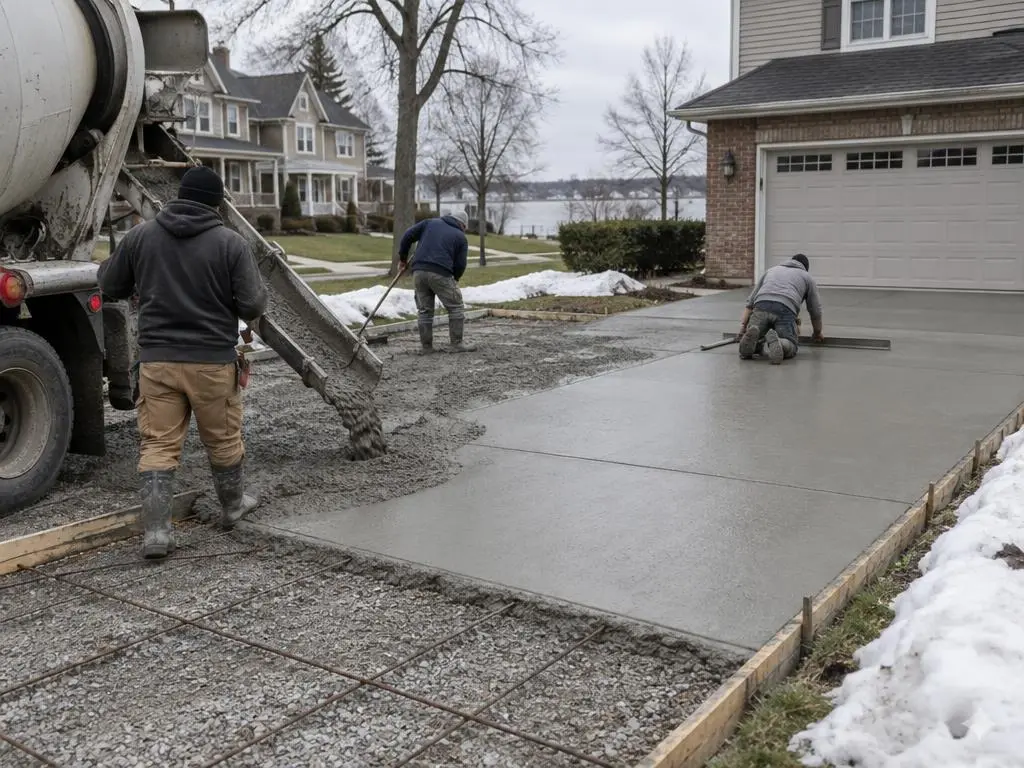
Our Concrete Services
Driveways, patios, stamped work, walks and steps, outbuilding slabs and repairs, each built around Aurora's freeze-thaw winters.
Concrete Driveways
Replacement and new driveways on a compacted stone base with air-entrained concrete, sized for what you park and built for plows and salt.
Learn more →Concrete Patios
Backyard patios and paths in broom, colored or exposed-aggregate finishes, pitched away from the house and laid out for how you use the yard.
Learn more →Stamped Concrete
Concrete patterned and colored to look like slate, stone or brick, sealed against freeze-thaw and salt.
Learn more →Sidewalks & Steps
Front walks, side paths, stoops and formed-in-place steps rebuilt level, with a clear line between your walk and the city's.
Learn more →Garage & Shed Slabs
Floors for detached garages, shed pads and equipment slabs, at the right thickness, pitched to drain and matched to the building.
Learn more →Concrete Repair & Replacement
Lifting sunken slabs, resurfacing scaled concrete, sealing cracks and replacing panels that cannot be saved.
Learn more →Common Questions
What should I compare when hiring residential concrete contractors in Aurora?
Line up two or three written bids and look past the bottom number. Check that each one states slab thickness, base depth, air-entrained concrete, steel, joint layout and who pulls the permit. Ask how the bidder handles the apron and public walk if the driveway reaches the street. A contractor who can explain why your old slab failed is more likely to keep the new one from failing the same way.
What does a new driveway cost around Aurora?
HomeGuide's national cost guide lists standard concrete driveways at $6 to $10 a square foot installed. Its size table shows $2,400 to $6,000 for a 400-square-foot two-car drive at standard to basic quality. Breaking out and hauling an old driveway is listed at another $2 to $6 a square foot. Local prices vary, so the measured quote is the real number.
Does Aurora require a permit for driveway work?
Aurora's Sidewalk and Driveway Replacement page points owners to the Division of Building and Permits, (630) 256-3130, for a Driveway Permit. We confirm the permit for your address and build it into the schedule.
Is the city responsible for my public sidewalk?
For walks in the public right-of-way, Aurora's Engineering Division evaluates the condition, and the city repairs sections with a 2-inch or larger vertical offset, three or more separated pieces, or scaling over half the surface. Where the walk crosses your driveway, the city and the owner share the work.
Why does my driveway peel every spring?
Peeling, or scaling, happens when water in the top layer freezes and expands, and salt multiplies the number of freeze cycles. Slabs without entrained air, slabs that were overworked during finishing and slabs salted in their first winter are the most prone. Shallow scaling on a sound slab can be resurfaced; deep scaling across most of the surface usually calls for replacement.
Can concrete be poured in late fall?
Yes, with care. The slab must not freeze before it gains strength, so we need mild nights in the forecast and may cover the concrete with insulated blankets. Once frost is in the ground, waiting for spring is usually the better call.
When can I use a new driveway?
Walking on it after a day or two is generally fine. HomeGuide says to keep cars off for at least a week and heavy trucks off for about 30 days. We give you dates based on your mix and that week's weather.
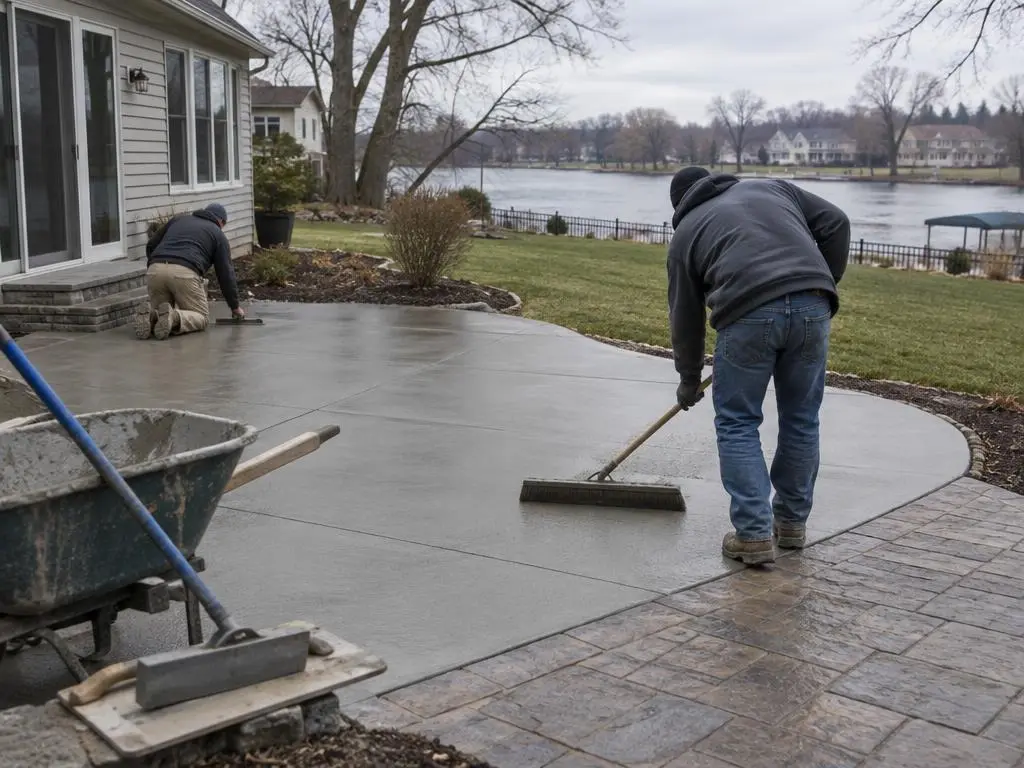
Why Homeowners Call Aurora Concrete Contractors
Made for freeze-thaw
Air-entrained mix, a drained stone base and planned joints on every outdoor slab.
Line-item pricing
Demolition, base, thickness, steel, finish and sealing each priced, so bids compare fairly.
Repair first when it works
Leveling or resurfacing quoted when the slab can be saved, not only a tear-out.
City programs explained
We show what sits in Aurora's right-of-way and whether its sidewalk repair or Driveway Assistance Program may apply.
Book a Free Concrete Estimate in Aurora
We measure on site and price the job in writing, anywhere in Aurora and the nearby Fox Valley towns.